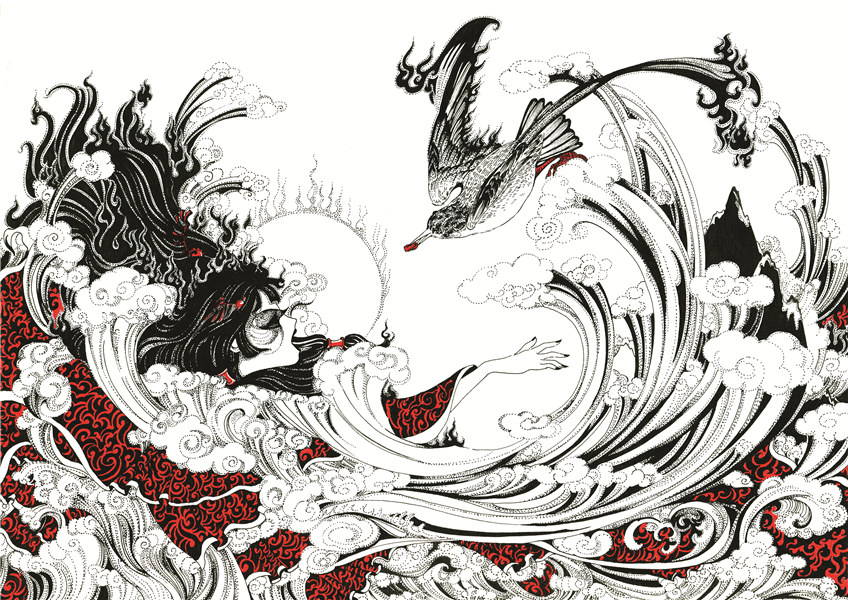
Shan Hai Jing
Introduction
Shan Hai Jing (Classic of Mountains and Seas), an ancient collection of Chinese texts dating back over 2,000 years, is a compilation that details the geography, mythology, and cultural aspects of ancient China before the Qin Dynasty (221-206 BC). It is renowned for its descriptions of various mythical creatures and sacred landscapes, which have inspired artists throughout history to visualize them in diverse artistic forms.
Historical Background
The Shan Hai Jing is estimated to have originated over 2,000 years ago, with its earliest sections likely compiled during the Warring States period (475-221 BC), making it an integral part of ancient Chinese literature and mythology. It is composed of 18 books covering various fields such as geography, botany, zoology, medicine, mythology, and ancient festivals, religions, and folk customs. The work is a comprehensive depiction of the world as perceived by ancient Chinese people, including around 40 states, 550 mountains, 300 waterways, over 100 historical figures, and 400 mythical creatures and monsters.
Mythical Creatures and Cultural Impact
Among the most celebrated mythical creatures from Shan Hai Jing are the Candle Dragon, Zouwu, and the Queen Mother of the West, Xiwangmu. The Candle Dragon, depicted as a mountain guardian with a red body and no feet, has been visualized in various forms by artists, including jade sculptors like Qiu Qijing. Zouwu is described as a large, colorful beast that can travel thousands of miles a day, and it has appeared in popular culture, such as in the "Fantastic Beasts" film series.
Xiwangmu, often portrayed with a leopard's tail and tiger's teeth in the original texts, represents the fierce and authoritative matron of plagues. Modern renditions by artists, like illustrator Chen Siyu, emphasize traits such as wild hair and all-seeing eyes, adapting her character to meet modern aesthetic sensibilities.
Artistic and Cultural Revivals
The mythical creatures and narratives of Shan Hai Jing continue to inspire contemporary artists and writers. For example, Chen Siyu's picture book series blends modern and traditional techniques to visually reinterpret these ancient myths for a new generation. Similarly, Shi Lin, a Chinese artist, draws inspiration from Shan Hai Jing to create vivid illustrations of mythical beasts, maintaining the integrity of his work despite commercial interests.
Shan Hai Jing has also been a source of inspiration for modern media, including fantasy films, television series, and video games. Its influence extends to global cultural exchanges, as seen in exhibitions and educational programs that highlight its themes alongside other ancient cultural works. The classic has been compared to works like Dante's "Divine Comedy", suggesting an ancient dialogue between Eastern and Western mythologies.
Scholarly Research and Interpretations
Researchers have explored the book's impact on global mythology, considering how its depictions of mythical creatures may have influenced or been influenced by other cultures through historical trade and communication routes.
In Japan, Shan Hai Jing was regarded as a geographical chronicle during the Sui and Tang dynasties (581-907) and has influenced Japanese folklore, particularly in the depiction of monsters and mythological creatures such as the nine-tailed fox.
Modern Adaptations and Legacy
The enduring legacy of Shan Hai Jing is evident in various modern adaptations, such as theatrical productions, animated series, and fashion collections inspired by its mythological content. These adaptations demonstrate the text's continued relevance and adaptability in exploring themes of mythology, culture, and human imagination.
In conclusion, Shan Hai Jing remains a significant cultural artifact, bridging ancient and modern worlds through its rich tapestry of myths and geographical lore. Its influence permeates contemporary creative expressions, ensuring that the mythical narratives of ancient China continue to captivate audiences worldwide.








